Us Navy Plane Plan Drawing

Aircraft carriers are warships that evolved from balloon-carrying wooden vessels into nuclear-powered vessels carrying scores of fixed- and rotary-wing shipping. Since their introduction they have allowed naval forces to project air ability great distances without having to depend on local bases for staging shipping operations.
Airship carriers were the first ships to deploy manned shipping, used during the 19th and early 20th century, mainly for observation purposes. The advent of fixed-wing aircraft in 1903 was followed in 1910 past the first flying from the deck of a United states Navy cruiser. Seaplanes and seaplane tender support ships, such as HMSEngadine, followed. The development of flat top vessels produced the first large fleet ships. This evolution was well underway by the early on to mid-1920s, resulting in the commissioning of ships such every bit Hōshō (1922), HMSHermes (1924),[1] Béarn (1927), and the Lexington-form aircraft carriers (1927).
Well-nigh early on aircraft carriers were conversions of ships that were laid down (or had even served) as different ship types: cargo ships, cruisers, battlecruisers, or battleships. During the 1920s, several navies started ordering and building aircraft carriers that were specifically designed as such. This allowed the pattern to exist specialized to their future role, and resulted in superior ships. During the 2nd World War, these ships would go the backbone of the carrier forces of the United states, British, and Japanese navies, known equally fleet carriers.
Globe War Two saw the outset large-scale use of shipping carriers and induced further refinement of their launch and recovery cycle leading to several design variants. The USA congenital small escort carriers, such equally USSBogue, as a stop-gap measure to provide air support for convoys and amphibious invasions. Subsequent light aircraft carriers, such every bit USSIndependence, represented a larger, more than "militarized" version of the escort carrier concept. Although the light carriers usually carried the same size air groups as escort carriers, they had the advantage of higher speed as they had been converted from cruisers under construction.
Early history - balloon and seaplane carriers [edit]


The earliest recorded case of using a ship for airborne operations occurred in 1806, when Lord Cochrane of the Majestic Navy launched kites from the 32-gun frigate HMSPallas in order to driblet propaganda leaflets.[ii] The proclamations against Napoleon Bonaparte, written in French, were attached to kites, and the kite strings were set debark; when the strings had burned through, the leaflets landed on French soil.[3]
Airship carriers [edit]
Merely over 40 years later on 12 July 1849,[iv] the Austrian Navy ship SMSVulcano was used for launching incendiary balloons. A number of pocket-size Montgolfiere hot air ballons were launched with the intention of dropping bombs on Venice. Although the endeavor largely failed due to contrary winds which drove the balloons back over the ship, one flop did land on the metropolis.[5]
After, during the American Civil State of war, nigh the time of the Peninsula Campaign, gas-filled balloons were used to perform reconnaissance on Confederate positions. The battles soon turned inland into the heavily forested areas of the Peninsula, nonetheless, where balloons could not travel. A coal barge, USSGeorge Washington Parke Custis, was cleared of all deck rigging to conform the gas generators and apparatus of balloons. From the barge Professor Thaddeus S. C. Lowe, Chief Aeronaut of the Union Army Airship Corps, made his first ascents over the Potomac River and telegraphed claims of the success of the first aerial venture ever made from a h2o-borne vessel. Other barges were converted to help with the other military balloons transported well-nigh the eastern waterways, just none of these Civil War craft ever took to the high seas.
Balloons launched from ships led to the development of balloon carriers, or balloon tenders, during World War I, by the navies of the United kingdom, France, Germany, Italy, Russia, and Sweden. Most ten such "balloon tenders" were congenital, their primary objective being aerial ascertainment posts. These ships were either decommissioned or converted to seaplane tenders later on the war.
Seaplane carriers [edit]

The outset seaplane carrier, the French Foudre (right, with hangar and crane), with ane of her Canard Voisin seaplanes taking off, during tactical exercises in June 1912
The invention of the seaplane in March 1910, with the French Fabre Hydravion, led to development of the earliest ship designed equally an shipping carrier, albeit limited to aircraft equipped with floats, in December 1911 with the French Navy Foudre, the outset seaplane carrier. Commissioned as a seaplane tender, and carrying seaplanes under hangars on the chief deck, from where they were lowered onto the sea with a crane, she participated in tactical exercises in the Mediterranean in 1912. Foudre was further modified in November 1913 with a 10-meter apartment deck to launch her seaplanes.[6]
HMSHermes, temporarily converted as an experimental seaplane carrier in April–May 1913, was also ane of the first seaplane carriers, and the first experimental seaplane carrier of the Royal Navy. She was originally laid down equally a merchant ship, just was converted on the building stocks to be a seaplane carrier for a few trials in 1913, earlier existence converted again to a cruiser, and dorsum again to a seaplane carrier in 1914. She was sunk by a German language submarine in Oct 1914. The offset seaplane tender of the U.s. Navy was the USSMississippi, converted to that role in December 1913.[7]
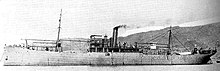
The Japanese seaplane carrier Wakamiya conducted the globe's first naval-launched air raids in September 1914.
In September 1914, during Globe War I, in the Battle of Tsingtao, the Imperial Japanese Navy seaplane carrier Wakamiya conducted the globe'southward first successful naval-launched air raids.[8] [ix] It lowered four Maurice Farman seaplanes into the h2o using its crane. These seaplanes later took off in order to bombard German forces, and were retrieved from the surface afterwards.[10]
On the Western front the offset naval air raid occurred on 25 December 1914 when twelve seaplanes from HMSEngadine, Riviera and Empress (cross-channel steamers converted into seaplane carriers) attacked the Zeppelin base at Cuxhaven.[11] The assault was not a consummate success, although a German warship was damaged; nevertheless the raid demonstrated in the European theatre the feasibility of assault by ship-borne aircraft and showed the strategic importance of this new weapon.
The Russians likewise were quite innovative in their use of seaplane carriers in the Blackness Sea theatre of World War I.[12]
Many cruisers and capital ships of the inter-war years often carried a catapult-launched seaplane for reconnaissance and spotting the autumn of shot. Such seaplanes were launched by a catapult and recovered by crane from the water after landing. They were successful even during Globe War II. At that place were many notable successes early in the war, such as HMSWarspite's float-equipped Swordfish during the Second Boxing of Narvik in 1940, which spotted for the guns of the British warships, helping to sink seven German destroyers, and sank the German language submarineU-64 with bombs.[13] The Japanese Nakajima A6M2-N "Rufe" floatplane, was derived from the Zero.
Genesis of the apartment-deck carrier [edit]
| "An airplane-carrying vessel is indispensable. These vessels will exist constructed on a plan very unlike from what is currently used. Commencement of all the deck will be cleared of all obstacles. Information technology volition exist flat, as wide every bit possible without jeopardizing the nautical lines of the hull, and it will look like a landing field." |
| Clément Ader, L'Aviation Militaire, 1909 (Come across note[xiv] for boosted quotes.) |
As heavier-than-air aircraft developed in the early on 20th century, various navies began to have an interest in their potential use as scouts for their big gun warships. In 1909 the French inventor Clément Ader published in his book 50'Aviation Militaire the description of a ship to operate airplanes at sea, with a flat flight deck, an island superstructure, deck elevators and a hangar bay. That year the US Naval Attaché in Paris sent a written report on his observations.[15]


Eugene Ely makes the first carrier landing on USSPennsylvania, xviii January 1911.
A number of experimental flights were made to examination the concept. Eugene Ely was the first pilot to launch from a stationary ship in November 1910. He took off from a structure fixed over the forecastle of the U.s. armored cruiser USSBirmingham at Hampton Roads, Virginia and landed nearby on Willoughby Spit subsequently some five minutes in the air.
On 18 January 1911, he became the first pilot to state on a stationary ship. He took off from the Tanforan racetrack and landed on a similar temporary structure on the aft of USSPennsylvania anchored at the San Francisco waterfront—the improvised braking system of sandbags and ropes led directly to the arrestor hook and wires described below. His shipping was then turned around and he was able to take off again.
Commander Charles Rumney Samson, Majestic Navy, became the kickoff airman to have off from a moving warship, on 9 May 1912. He took off in a Short S.38 from the battleship HMSHibernia while she steamed at fifteen kn (17 mph; 28 km/h) during the Purple Fleet Review at Weymouth, England.[xvi]
Flat-deck carriers in World War I [edit]
HMSArk Royal was arguably the first active shipping carrier, equally it carried armed seaplanes for apply in combat and military operations. She was originally laid down as a merchant send, simply was converted on the building stocks to exist a hybrid airplane/seaplane carrier with a launch platform. Launched on 5 September 1914, she served in the Dardanelles campaign and throughout Globe War I. The transport proved to exist as well slow to work with the Thousand Fleet and for operations in the North Bounding main in general, so Ark Royal was ordered to the Mediterranean in mid-January 1915 to support the Gallipoli campaign.[17]
HMSFurious was the first ship to be designed with the same basic features as modernistic aircraft carriers, as it was the first shipping carrier to be equipped with a flight deck for airplanes although its initial flight decks were in two portions and therefore were not continuously full-length with the ship. This transport was rebuilt in 1925 with a full-length flight deck, and served in combat operations during World State of war 2. Since HMSArk Majestic was a seaplane carrier, information technology had no actual flight deck; the planes that it carried would have off and land on the sea, and would so be hoisted aboard by shipboard cranes.
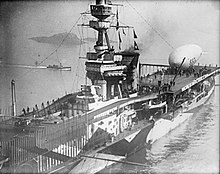
HMSFurious in 1918 with flight decks fore and aft of the superstructure
During World War I the Royal Navy used HMSFurious to experiment with the use of wheeled aircraft on ships. This ship was reconstructed three times between 1915 and 1925: commencement, while still under construction, it was modified to receive a flight deck on the fore-deck; in 1917 it was reconstructed with separate flight decks fore and aft of the superstructure; then finally, subsequently the war, information technology was heavily reconstructed with a three-quarter length main flight deck, and a lower-level takeoff-simply flight deck on the fore-deck.
On two August First attack using an air-launched torpedo, from a Short Type 184 seaplane flown past Flying Commander Charles H. K. Edmonds from seaplane carrier HMSBen-my-Chree.[eighteen] [19]
On 2 August 1917, Squadron Commander Eastward.H. Dunning, Regal Navy, landed his Sopwith Pup shipping on HMSFurious in Scapa Flow, Orkney, condign the first homo to land a plane on a moving ship.[20] He was killed 5 days after during another landing on Furious.[xx]
Of carrier operations mounted during the state of war, 1 of the near successful took identify on 19 July 1918 during the Tondern raid when seven Sopwith Camels launched from HMS Furious attacked the German Zeppelin base at Tondern, with 2 50 lb (23 kg) bombs each. Several airships and balloons were destroyed, but every bit the carrier had no method of recovering the aircraft, two of the pilots ditched their aircraft in the body of water aslope the carrier while the others headed for neutral Kingdom of denmark. This was the first e'er carrier-launched airstrike.[21]
Inter-war years [edit]
The Washington Naval Treaty of 1922 placed strict limits on the tonnages of battleships and battlecruisers for the major naval powers after World State of war I, likewise as not only a limit on the total tonnage for carriers, but also an upper limit of 27000 tons for each ship. Although exceptions were made regarding the maximum ship tonnage, fleet units counted, experimental units did not, the total tonnage could not be exceeded. However, while all of the major navies were over-tonnage on battleships, they were all considerably nether-tonnage on shipping carriers. Consequently, many battleships and battlecruisers under structure (or in service) were converted into aircraft carriers.
HMS Argus: the first full-length flat deck [edit]
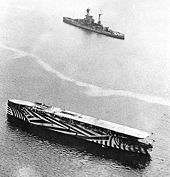
The first full-length apartment deck, HMSArgus in 1918
The first send to have a full-length flat deck was HMSArgus, the conversion of which was completed in September 1918. The United states Navy did not follow suit until 1920, when the conversion of USSLangley, an experimental ship which did not count against America'south carrier tonnage, was completed. The outset American fleet carriers would not enter service until November 1927 when USSSaratoga of the Lexington-class was commissioned. The pb transport of the class, USSLexington, was commissioned the following calendar month.
Hōshō: the first purpose-congenital aircraft carrier commissioned [edit]
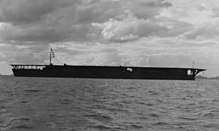
The IJN's 1922 Hōshō was the outset purpose-built aircraft carrier to be deputed.[22]
The first purpose-designed aircraft carrier to be laid down was HMSHermes (1924) in 1918. Japan began work on Hōshō the post-obit year. In Dec 1922, Hōshō became the beginning to exist commissioned, while Hermes was commissioned in February 1924.[22] [23]
HMS Hermes (1924): the first off-set control tower [edit]

The pattern of HMS Hermes (1924) preceded and influenced that of Hōshō, and its construction actually began before, but numerous tests, experiments and budget considerations delayed its commission. The long gestation of Hermes resulted finally in the first shipping carrier to display the two most distinctive features of a modern aircraft carrier: the full-length flying deck and the starboard-side control tower isle. With the exception of the squared-off flying deck prow and angled flight deck of afterward carriers, Hermes was the first to brandish the chief features of the classic silhouette and program layout of the nifty majority of aircraft carriers produced over the next century.
HMS Hermes (1924) was commissioned 2 days earlier than a sister aircraft carrier, HMSEagle. Similar Hermes, Eagle had a full-length flying deck and a starboard-side control tower isle. Unlike Hermes, however, Hawkeye was a converted battleship and had a less integrated pattern and appearance than the purpose-designed Hermes.
Hurricane bow [edit]
A "hurricane bow" is a bow sealed upwards to the flight deck, outset seen on HMSHermes (1924). The American Lexington-form carriers also featured this when they entered service in 1927. Combat feel proved it to be by far the about useful configuration for the bow of the ship among others that were tried, including an additional flying-off deck and an anti-aircraft battery.[ citation needed ] The latter was the nigh common American configuration during World War Ii, seen in the Essex-class (the "long-hull" variant),[ citation needed ] and information technology was not until after the war when a majority of American carriers incorporated the hurricane bow. The first Japanese carrier with a hurricane bow was Taihō.
Important innovations merely before and during World War Two [edit]
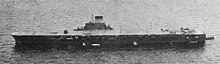
The Japanese carrier Taihō had a hurricane bow.
By the late 1930s, carriers around the world typically carried three types of shipping: torpedo bombers, also used for conventional bombings and reconnaissance; swoop bombers, also used for reconnaissance (in the U.S. Navy, aircraft of this blazon were known as "scout bombers"); and fighters for fleet defense and bomber escort duties. Considering of the restricted space on aircraft carriers, all these shipping were of small, single-engined types, unremarkably with folding wings to facilitate storage. In the late 1930s, the RN too developed the concept of the armoured flight deck, enclosing the hangar in an armoured box. The atomic number 82 send of this new type, HMSIllustrious, commissioned in 1940.
Light aircraft carriers [edit]
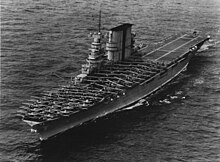
Prior to the beginning of the war, President Franklin D. Roosevelt noticed that no new aircraft carriers were expected to enter the fleet earlier 1944, and proposed the conversion of several Cleveland-form cruiser hulls that had already been laid downwardly. They were intended to serve as additional fast carriers, as escort carriers did not have the requisite speed to keep up with the armada carriers and their escorts. The actual U.S. Navy nomenclature was small aircraft carrier (CVL), not calorie-free. Prior to July 1943, they were merely classified as shipping carriers (CV).[24]
The Regal Navy fabricated a similar design which served both Britain and the Democracy countries subsequently Globe War II. One of these carriers, HMSHermes (1959), was in employ equally India's INSViraat, until information technology was decommissioned in 2017.
Escort carriers and merchant aircraft carriers [edit]
To protect Atlantic convoys, the British developed what they chosen Merchant Shipping Carriers, which were merchant ships equipped with a apartment deck for half-dozen aircraft. These operated with civilian crews, under merchant colors, and carried their normal cargo besides providing air back up for the convoy. As at that place was no lift or hangar, aircraft maintenance was limited and the aircraft spent the entire trip sitting on the deck.
These served as a stop-gap measure out until dedicated escort carriers (CVE) could be built in the U.Southward. Near a 3rd of the size of a fleet carrier, they carried between 20 and thirty aircraft, by and large for anti-submarine duties. Over 100 were built or converted from merchantmen. Escort carriers were built in the US from 2 basic hull designs: one from a merchant transport, and the other from a slightly larger, slightly faster tanker. As well defending convoys, these were used to transport aircraft across the ocean. Nevertheless, some participated in the battles to liberate the Philippines, notably the Battle off Samar in which half-dozen escort carriers and their escorting destroyers aggressively attacked v Japanese battleships and bluffed them into retreating.
Catapult aircraft merchantmen [edit]
As an emergency stop-gap before sufficient merchant aircraft carriers became available, the British provided air cover for convoys using Catapult shipping merchantman (CAM ships). CAM ships were merchant vessels equipped with an aircraft, commonly a battle-weary Hawker Hurricane, launched by a catapult. Once launched, the aircraft could non country dorsum on the deck and had to ditch in the sea if it was not inside range of land. In over two years, fewer than ten launches were ever made, even so these flights did take some success: 6 bombers for the loss of a single airplane pilot.
Earth War II [edit]


Iv The states Navy carriers correct afterwards the war, showing size and length differences: Saratoga (bottom), an early battlecruiser conversion; Enterprise (2nd from bottom), an early fleet carrier; Hornet (3rd from lesser), a war-fourth dimension built Essex-class carrier; and San Jacinto (top), a low-cal carrier based on a cruiser hull.
Aircraft carriers played a significant role in Globe War 2. With 7 aircraft carriers afloat, the Purple Navy had a considerable numerical advantage at the start of the state of war as neither the Germans nor the Italians had carriers of their own.[25] Even so, the vulnerability of carriers compared to traditional battleships when forced into a gun-range meet was quickly illustrated by the sinking of HMSGlorious by German battlecruisers during the Norwegian campaign in 1940. The get-go British warship lost in the war was HMSCourageous sunk by U-29 on 17 September 1939.
The versatility of the carrier was demonstrated in Nov 1940 when HMS Illustrious launched a long-range strike on the Italian armada at Taranto signalling the beginning of the constructive mobile aircraft strikes, past brusque-ranged aircraft. This performance incapacitated three of the six battleships in the harbour at a cost of 2 of the 21 attacking Fairey Swordfish torpedo bombers. Carriers also played a major part in reinforcing Malta, both by transporting planes and past defending convoys sent to supply the besieged island. The utilise of carriers prevented the Italian Navy and country-based German shipping from dominating the Mediterranean theatre.
In the Atlantic, aircraft from HMSArk Regal and HMSVictorious were responsible for slowing the German battleship Bismarck during May 1941. Afterwards in the war, escort carriers proved their worth guarding convoys crossing the Atlantic and Arctic oceans.
Germany and Italia likewise started with the construction or conversion of several shipping carriers, simply with the exception of the virtually finished Graf Zeppelin, no send was launched.
Globe War 2 in the Pacific Ocean involved clashes between shipping carrier fleets. Japan started the war with ten aircraft carriers, the largest and most modernistic carrier fleet in the world at that time. There were seven American aircraft carriers at the get-go of the hostilities, although only three of them were operating in the Pacific.
Cartoon on the 1939 Japanese development of shallow-water modifications for aerial torpedoes and the 1940 British aeriform attack on the Italian armada at Taranto, the 1941 Japanese surprise set on on Pearl Harbor was a articulate illustration of the power projection capability afforded by a big force of modern carriers. Concentrating six carriers in a single striking unit marked a turning point in naval history, equally no other nation had fielded anything comparable.
Meanwhile, the Japanese began their advance through Southeast Asia, and the sinking of Prince of Wales and Repulse past Japanese land-based aircraft proved in certitude that aircraft, and aircraft carrying warships, would boss the seas. For the first fourth dimension in naval history aircraft had sunk a battleship while maneuvering at body of water and fighting dorsum. In April 1942, the Japanese fast carrier strike forcefulness ranged into the Indian Bounding main and sank shipping, including the damaged and undefended carrier HMSHermes (1924). Smaller Centrolineal fleets with inadequate aerial protection were forced to retreat or exist destroyed. The Doolittle Raid, consisting of 16 B-25 Mitchell medium bombers launched from USSHornet against Tokyo, forced the retrieve of the Japanese strike force to dwelling waters. In the Battle of the Coral Bounding main, the globe's first carrier battle[26] and 1 in which fleets only exchanged blows with aircraft became a tactical victory for the Japanese, merely a strategic victory for the allies. For the kickoff time in history, at the Battle of Midway, a naval boxing was decisively fought past aircraft and non warships; all four Japanese carriers engaged were sunk by planes from iii American carriers (one of which was lost); the boxing is considered the turning indicate of the war in the Pacific. Notably, the boxing was orchestrated by the Japanese to draw out American carriers that had proven very elusive and troublesome to the Japanese.
Later on, the U.s.a. was able to build upwards large numbers of aircraft aboard a mixture of fleet, light and (newly commissioned) escort carriers, primarily with the introduction of the Essex-class in 1943. These ships, around which were built the fast carrier task forces of the tertiary and 5th Fleets, played a major part in winning the Pacific state of war. The Battle of the Philippine Sea in 1944 was the largest aircraft carrier battle in history and the decisive naval boxing of World War II.
The reign of the battleship equally the master component of a fleet finally came to an cease when U.Southward. carrier-borne aircraft sank the largest battleships ever congenital, the Japanese super battleships Musashi in 1944 and Yamato in 1945. Nippon built the largest aircraft carrier of the war: Shinano, which was a Yamato-form ship converted before existence halfway completed in order to counter the disastrous loss of iv fleet carriers at Midway. She was sunk past the patrolling US submarine Archerfish while in transit shortly after commissioning, merely before beingness fully outfitted or operational, in Nov 1944.
Wartime emergencies as well spurred the creation or conversion of anarchistic aircraft carriers. CAM ships, like SSMichael E, were cargo-carrying merchant ships that could launch but non retrieve a single fighter aircraft from a catapult. These vessels were an emergency mensurate during World War Ii as were the Merchant aircraft carriers (MACs), such as MVEmpire MacAlpine which put a flight deck on top of a cargo send. Submarine aircraft carriers, such as the French Surcouf and the Japanese I-400-grade submarines, which was capable of carrying three Aichi M6A Seiran aircraft, were showtime built in the 1920s merely were generally unsuccessful at war.
Mail service-state of war developments [edit]

Iii major post-state of war developments came from the demand to better operations of jet-powered shipping, which had higher weights and landing speeds than their propeller-powered forebears.
The showtime jet landing on a carrier was made by Lt Cdr Eric "Winkle" Dark-brown who landed on HMSBounding main in the specially modified de Havilland Vampire LZ551/Thousand on 3 December 1945.[27] Brown is also the all-time record holder for the number of carrier landings, at 2,407.[27]
Subsequently these successful tests, there were still many misgivings almost the suitability of operating jet aircraft routinely from carriers, and LZ551/G was taken to Farnborough to participate in trials of the experimental "rubber deck". Despite significant effort toward developing this idea, and some performance advantages due to the removal of the undercarriage, it was institute to exist unnecessary; and following the introduction of angled flight decks, jets were operating from carriers by the mid-1950s.[27]
Angled decks [edit]
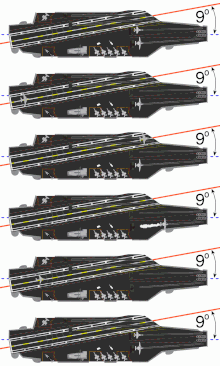
The angled flying deck allows for rubber simultaneous launch and recovery of shipping.
During World War II, aircraft would land on the flight deck parallel to the long centrality of the ship's hull. Aircraft which had already landed would be parked on the deck at the bow end of the flying deck. A crash bulwark was raised backside them to finish any landing aircraft which overshot the landing surface area because its landing hook missed the arrestor cables. If this happened, it would oft crusade serious damage or injury and even, if the crash barrier was non strong enough, destruction of parked aircraft.
An important development of the early 1950s was the introduction by the Royal Navy of the angled flying deck past Capt D.R.F. Campbell RN in conjunction with Lewis Boddington of the Regal Aircraft Establishment at Farnborough.[27] The runway was canted at an angle of a few degrees from the longitudinal axis of the ship. If an aircraft missed the arrestor cables (referred to as a "bolter"), the pilot only needed to increment engine power to maximum to get airborne again, and would not striking the parked aircraft because the angled deck pointed out over the sea.
The angled flight deck was first tested on HMSTriumph, past painting angled deck markings onto the centerline flight deck for touch and go landings.[28] This was besides tested on USSMidway the aforementioned twelvemonth.[29] [30] In both tests, the arresting gear and barriers remained oriented to the original centrality deck. During September through Dec 1952 USSAntietam had a rudimentary sponson installed for true angled deck tests, allowing for full arrested landings, which proved during trials to be superior.[29] In 1953 Antietam trained with both US and British naval units, proving the worth of the angled deck concept.[31] HMSCentaur was modified with an overhanging angled flight deck in 1954.[28] The United states Navy installed the decks every bit office of the SCB-125 upgrade for the Essex-class and SCB-110/110A for the Midway-course. In Feb 1955, HMSArk Regal became the beginning carrier to be synthetic and launched with the deck, followed in the same year by the lead ships of the British Imperial-class (HMASMelbourne) and the American Forrestal-class (USSForrestal).[28]
Steam catapults [edit]
The modern steam-powered catapult, powered by steam from the ship's boilers or reactors, was invented by Commander C.C. Mitchell of the Royal Naval Reserve.[27] It was widely adopted following trials on HMSPerseus between 1950 and 1952 which showed information technology to be more powerful and reliable than the hydraulic catapults which had been introduced in the 1940s.[27]
Optical Landing Systems [edit]
The first of the Optical Landing Systems was some other British innovation, the Mirror Landing Aid invented by Lieutenant Commander H. C. N. Goodhart RN.[27] This was a gyroscopically-controlled concave mirror (in subsequently designs replaced by a Fresnel lens Optical Landing System) on the port side of the deck. On either side of the mirror was a line of greenish "datum" lights. A bright orange "source" lite was directed into the mirror creating the "ball" (or "meatball" in later USN parlance), which could be seen by the aviator who was most to land. The position of the ball compared to the datum lights indicated the shipping's position in relation to the desired glidepath: if the brawl was higher up the datum, the plane was loftier; beneath the datum, the plane was depression; between the datum, the plane was on glidepath. The gyro stabilisation compensated for much of the movement of the flight deck due to the sea, giving a constant glidepath. The first trials of a mirror landing sight were conducted on HMS Illustrious in 1952.[27] Prior to OLSs, pilots relied on visual flag signals from Landing Signal Officers to assistance maintain proper glidepath.
Nuclear age [edit]
The Us Navy attempted to get a strategic nuclear force in parallel with the United States Air Force (USAF) long-range bombers with the project to build United States. This ship would have carried long range twin-engine bombers, each of which could deport an atomic bomb. The project was canceled under pressure from the newly created United States Air Forcefulness. This only delayed the growth of carriers. Nuclear weapons would be part of the carrier weapons load, despite Air Forcefulness objections, beginning in 1950 aboard USSFranklin D. Roosevelt and continuing in 1955 aboard USSForrestal. By the end of the 1950s the Navy had a series of nuclear-armed attack aircraft.
The United states Navy also congenital the first aircraft carrier to be powered by nuclear reactors. USSEnterprise was powered by eight nuclear reactors and was the second surface warship, after USSLong Embankment, with nuclear propulsion. Subsequent nuclear supercarriers starting with USSNimitz took reward of this technology to increase their endurance utilizing only two reactors. While other nations operate nuclear-powered submarines, thus far only France has a nuclear-powered carrier, Charles de Gaulle.
Helicopters [edit]
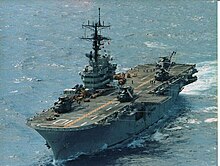
The post-war years also saw the evolution of the helicopter, with a variety of useful roles and mission capability aboard aircraft carriers. Whereas stock-still-wing shipping are suited to air-to-air combat and air-to-surface assail, helicopters are used to transport equipment and personnel and tin be used in an anti-submarine warfare (ASW) role, with dipping sonar, air-launched torpedoes, and depth charges; as well as for anti-surface vessel warfare, with air-launched anti-ship missiles.
In the late 1950s and early 1960s, the United Kingdom and the Usa converted some older carriers into helicopter carriers or Landing Platform Helicopters (LPH); seagoing helicopter bases like HMSBarrier. To mitigate the expensive connotations of the term "aircraft carrier", the new Invincible-class carriers were originally designated as "through deck cruisers"[ citation needed ] and were initially to operate every bit helicopter-only escort carriers. The inflow of the Body of water Harrier VTOL/STOVL fast jet meant they could carry fixed-wing aircraft, despite their short flight deck.
The United States used some Essex-form carriers initially every bit pure anti-submarine warfare (ASW) carriers, embarking helicopters and fixed-wing ASW shipping like the Southward-two Tracker. Later, specialized LPH helicopter carriers for the transport of Marine Corps troops and their helicopter transports were developed. These evolved into the Landing Helicopter Set on (LHA) and subsequently into the Landing Helicopter Dock (LHD) classes of amphibious assault ships, which normally also embark a few Harrier aircraft.
Ski-jump ramp [edit]

Another British innovation was the ski-spring ramp every bit an alternative to contemporary catapult systems.[27] The ski-leap ramp at the cease of a track or flying deck allows an aircraft which makes a running get-go to convert function of its forward momentum into upward move. The intent is that the additional altitude and upward-angled flight path from the leap provides actress time until the forrad airspeed generated by engine thrust is high enough to maintain level flight. STOVL aircraft often also use their ability to direct some of their thrust downwards to give them boosted lift until required airspeed is attained.
Equally the Royal Navy retired or sold the last of its World War II-era carriers, they were replaced with smaller ships designed to operate helicopters and the STOVL Bounding main Harrier jet. The ski-jump gave the Harriers an enhanced STOVL capability, assuasive them to take off with heavier payloads.[32] It was afterward adopted by the navies of other nations including India, Spain, Italy, Russia, and Thailand.
Post-Earth War II conflicts [edit]
Un carrier operations in the Korean War [edit]
The Un command began carrier operations against the North Korean Army on July 3, 1950, in response to the invasion of South Korea. Task Force 77 consisted at that time of the carriers USSValley Forge and HMSTriumph. Before the armistice of July 27, 1953, twelve U.S. carriers served 27 tours in the Sea of Nippon as part of Task Force 77. During periods of intensive air operations as many as 4 carriers were on the line at the same time (see Attack on the Sui-ho Dam), but the norm was 2 on the line with a third "ready" carrier at Yokosuka able to respond to the Sea of Nihon at short notice.
A second carrier unit of measurement, Task Force 95, served as a occludent force in the Yellow Sea off the due west coast of North Korea. The task forcefulness consisted of a Commonwealth lite carrier (HMSTriumph, Theseus, Glory, Ocean, and HMASSydney) and usually a U.Southward. escort carrier (USSBadoeng Strait, Bairoko, Point Cruz, Rendova, and Sicily).
Over 301,000 carrier sorties were flown during the Korean War: 255,545 by the aircraft of Job Force 77; 25,400 past the Commonwealth aircraft of Task Strength 95, and 20,375 past the escort carriers of Task Force 95. Usa Navy and Marine Corps carrier-based combat losses were 541 aircraft. The Fleet Air Arm lost 86 aircraft in gainsay, and the Australian Armada Air Arm xv.
Post-colonial conflicts [edit]
In the period following Globe War II through the 1960s, the Uk, French republic, and kingdom of the netherlands employed their carriers during decolonization conflicts of former colonies.
France employed the carriers Dixmude, La Fayette, Bois Belleau, and Arromanches to conduct operations against the Viet Minh during the 1946–1954 Offset Indochina War.[33]
The United kingdom used carrier-based aircraft from HMSEagle, HMSAlbion, and HMSBulwark, and France from Arromanches and La Fayette, to attack Egyptian positions during the 1956 Suez Crisis. Royal Navy carriers HMSOcean and Theseus acted as floating bases to ferry troops ashore by helicopter in the commencement ever big-scale helicopter-borne assault.[34]
The Majestic Netherlands Navy deployed HNLMSKarel Doorman and an escorting battle grouping to Western New Republic of guinea in 1962 to protect it from Indonesian invasion. This intervention near resulted in her beingness attacked by the Indonesian Air Force using Soviet supplied Tupolev Tu-16KS-i Badger naval bombers carrying anti-ship missiles. The set on was called off by a final-infinitesimal cease burn.[35]
Betwixt 1964 and 1967, the Royal Navy deployed the Far East Fleet carriers Ark Purple, Centaur, and HMSVictorious in support of operations in Borneo during the Konfrontasi disharmonize between Indonesia and Malaysia. HMS Albion and Barrier were deployed as commando carriers, and the Australian carrier HMAS Sydney served as a troop transport.[36]
Indo-Islamic republic of pakistan War of 1971 [edit]
During the war, Republic of india deployed INSVikrant against Pakistan from its station in the Andaman Islands for operations confronting Pakistani forces in the East (nowadays 24-hour interval Bangladesh). Hawker Sea Hawks from the carrier successfully choked the Chittagong harbour and put information technology out of service.
U.S. carrier operations in Southeast Asia [edit]
The Us Navy fought "the almost protracted, biting, and costly war"[37] in the history of naval aviation from August two, 1964, to August 15, 1973, in the waters of the South People's republic of china Body of water. Operating from two deployment points (Yankee Station and Dixie Station), carrier aircraft supported gainsay operations in South Vietnam and conducted bombing operations in conjunction with the U.S. Air Force in North Vietnam under Operations Flaming Sprint, Rolling Thunder, and Linebacker. The number of carriers on the line varied during differing points of the disharmonize, just as many every bit six operated at one time during Operation Linebacker.
Twenty-1 aircraft carriers, all of the attack carriers operational during the era except John F. Kennedy, deployed to Task Force 77 of the U.s. Seventh Armada, conducting 86 war cruises and operating 9,178 full days on the line in the Gulf of Tonkin. 530 shipping were lost in gainsay and 329 more in operational accidents, causing the deaths of 377 naval aviators, with 64 others reported missing and 179 captured. 205 officers and men of the ship's complements of three carriers Forrestal, Enterprise, and Oriskany, were killed in major shipboard fires. At times some of the carrier groups operated over 12,000 miles from their habitation ports.
Falklands War [edit]

During the Falklands War the United Kingdom was able to win a disharmonize eight,000 miles (xiii,000 km) from home in large part due to the apply of the lite fleet carrier HMSHermes (1959) and the smaller "through deck cruiser" carrier HMSInvincible. The Falklands showed the value of STOVL shipping, the Hawker Siddeley Harrier, both the RN Ocean Harrier and press-ganged RAF Harrier variants, in defending the fleet and assault force from shore-based aircraft and in attacking the enemy. Sea Harriers shot down 21 fast-attack jets and suffered no aerial gainsay losses, although six were lost to accidents and ground fire. Helicopters from the carriers were used to deploy troops and for medevac, search and rescue and anti-submarine warfare.
Another lesson from the Falklands War resulted in the withdrawal of Argentine republic's shipping carrier ARA Veinticinco de Mayo with her A-4Qs. The sinking of the Argentine cruiser ARA General Belgrano by the fast attack submarine HMS Conquistador showed that capital ships were vulnerable in nuclear submarines' hunting grounds.
Operations in the Farsi Gulf [edit]
The U.South. has also made use of carriers in the Farsi Gulf and Afghanistan and to protect its interests in the Pacific. During the 2003 invasion of Iraq U.S. aircraft carriers served as the primary base of American air ability. Even without the ability to place significant numbers of aircraft in Middle Eastern airbases, the The states was capable of carrying out meaning air attacks from carrier-based squadrons. Recently, U.S. aircraft carriers such as the Ronald Reagan provided air support for counter-insurgency operations in Republic of iraq.
Cardinal technologies [edit]
| Feature | Kickoff seen | First demonstrated on/at | Showtime commissioned carrier | Entry into service | Notes |
|---|---|---|---|---|---|
| Flying takeoff deck | 1910 | USSBirmingham(CL-two) | HMSRepulse(1916) | 1917 | |
| Full length flight deck | 1918 | HMSArgus(I49) | HMS Argus (I49) | 1918 | |
| Angled flight deck | 1948 | HMSWarrior(R31) | USSAntietam(CV-36) | 1952 | |
| Aircraft elevators | 1918 | HMSArgus(I49) | HMS Argus (I49) | 1918 | |
| Purpose built carrier | 1918 | HMSHermes(95) | IJN Hōshō | 1922 | |
| Arresting gear | 1911 | USSPennsylvania(ACR-4) | HMSArgus(I49) | 1918 | Argus was fitted with longitudinal gear, past W.A.D.Forbes |
| Transverse arrestor gear | 1922 | USSLangley(CV-1) | Béarn | 1927 | |
| Hydraulic Arrestor Gear | 1927 | Béarn | Béarn | 1927 | |
| Starboard Island | 1924 | HMSHermes(95) | HMS Hermes (95) | 1924 | |
| Hurricane Bow | 1924 | HMSHermes(95) | HMS Hermes (95) | 1924 | |
| Aircraft catapult | 1915 | USSNorthward Carolina(ACR-12) | USSLangley(CV 1) - compressed air USSLexington(CV-2) - flly cycle HMSCourageous(fifty) - hydraulic | 1922 1927 1934 | LCDR Henry Mustin made the starting time successful launch on five November 1915, |
| Steam Catapult | 1950 | HMSPerseus(R51) | HMSArk Royal(R09) USSHancock(CV-xix) USSShangri-La(CVA-38) | 1955 | Added to Hancock and Shangri-La during their SCB-27C/125 refits. |
| Jet Aviation | 1945 | HMSOcean(R68) | USSSaipan(CVL-48) | 1948 | A Sea Vampire flown past Eric "Winkle" Brown made the showtime always carrier landing on iv December 1945 |
| Optical landing organisation | 1953 | HMSIllustrious(87) | HMSArk Royal(R09) | 1955 | Invented in 1951 by Nicholas Goodhart |
| Nuclear marine propulsion | 1961 | USSEnterprise(CVN-65) | USS Enterprise CVN-65 | 1961 | |
| Ski-bound | 1973 | RAE Bedford | HMSInvincible(R05) | 1977 | |
| EMALS | 2010 | Lakehurst Maxfield Field | USSGerald R. Ford(CVN-78) | 2017 |
See also [edit]
- Modern United States Navy carrier air operations
- Project Habakkuk
- Seadrome
- Mobile offshore base (concept)
- Airborne aircraft carrier
- Floating drome (concept)
Types of ships that carry aircraft [edit]
- ASW carrier
- Escort carrier
- Helicopter carrier
- Light aircraft carrier
- Supercarrier
- Amphibious assault ship
- Seaplane tender
- Balloon carrier
- Submarine shipping carrier
[edit]
- List of shipping carriers
- Listing of aircraft carriers by country
- List of shipping carriers by type
- List of aircraft carrier classes of the United States Navy
- List of aircraft carriers in service
- Timeline for aircraft carrier service
- Listing of amphibious warfare ships
References [edit]
Notes [edit]
- ^ Annotation: 3 generations of Royal Navy aircraft carriers named HMS Hermes are mentioned in this commodity: HMSHermes(1898), HMSHermes (1924), and HMSHermes (1959),
- ^ Military machine Ballooning During the Early Civil War, p 96, F. Stansbury Haydon, JHU Press, 2000, ISBN 0-8018-6442-nine
- ^ Chambers's Supplementary Reader, p 12, West. and R. Chambers, BiblioBazaar, 2008, ISBN 0-554-87195-5
- ^ van Beverhoudt, Jr., Arnold E. (2003-01-01). "Carriers: Airpower at Sea - The Early on Years / Function i". sandcastlevi.com. Sandcastle Half dozen. Retrieved 2007-08-03 .
- ^ War machine Shipping, Origins to 1918, p 10, Justin D. Murphy, ABC-CLIO, 2005, ISBN 1-85109-488-1
- ^ Clarification and photograph of Foudre
- ^ "First U.s.a. seaplane carrier, the USS Mississippi". Hazegray.org. Retrieved 2009-01-30 .
- ^ Wakamiya is "credited with conducting the kickoff successful carrier air raid in history"Source:GlobalSecurity.org
- ^ "Sabre et pinceau", Christian Polak, p. 92.
- ^ IJN Wakamiya Aircraft Carrier
- ^ Barry Watts and Williamson Murray, "Military machine Innovation in Peacetime," in Murray, Williamson; Millet, Allan R, eds. (1996). Military Innovation in the Interwar Period. New York: Cambridge University Press. p. 385. ISBN0-521-63760-0.
- ^ Halpern, Paul G. (11 October 2012). A Naval History of World War I. Naval Institute Printing. ISBN9781612511726.
- ^ Green, William (1962). War Planes of the 2d World War: Volume Six: Floatplanes. London: Macdonald. pp. xc–91.
- ^ Clement Ader on the construction of the aircraft carrier:
"An airplane-conveying vessel is indispensable. These vessels will be constructed on a plan very different from what is currently used. Showtime of all the deck will be cleared of all obstacles. Information technology will be flat, as wide as possible without jeopardizing the nautical lines of the hull, and information technology will look like a landing field." Military Aviation, p35
On stowage:
"Of necessity, the airplanes will be stowed below decks; they would exist solidly fixed anchored to their bases, each in its identify, so they would non be affected with the pitching and rolling. Access to this lower decks would be past an lift sufficiently long and wide to hold an airplane with its wings folded. A big, sliding trap would cover the hole in the deck, and information technology would have waterproof joints, so that neither rain nor seawater, from heavy seas could penetrate below." Military Aviation, p36
On the technique of landing:
"The transport volition be headed direct into the air current, the stern clear, but a padded barrier set up upwards forward in case the airplane should run past the stop line" Military Aviation, p37. - ^ van Beverhoudt, Arnold E., Jr. (2003-01-01). "Carriers: Airpower at Sea - The Early Years / Office ii". sandcastlevi.com. Sandcastle Six. Retrieved 19 October 2017.
- ^ Barnes C.H. & James D.North (1989). Shorts Aircraft since 1900. London: Putnam. p. sixty. ISBN0-85177-819-4.
- ^ Friedman, p. 28
- ^ Sturtivant (1990), p.215
- ^ 269 Squadron History: 1914–1923
- ^ a b "HMS Furious 1917". Royal Navy. RN official web site. Archived from the original on thirteen June 2008. Retrieved 10 Jan 2009.
- ^ Probert, p. 46
- ^ a b "Hōshō was a carrier from the keel, the beginning of its kind completed in any navy of the globe" Scot MacDonald U.s. Navy History: Development of Aircraft Carriers
- ^ "The Imperial Japanese Navy was a pioneer in naval aviation, having commissioned the world's first built-from-the-keel-upward carrier, the Hosho." GlobalSecurity: Carrier Hosho.
- ^ CVL—Pocket-size Aircraft Carriers, Naval Historical Centre, http://www.history.navy.mil/photos/shusn-no/cvl-no.htm. Retrieved 22 September 2006.
- ^ Black, Jeremy (2003). World State of war Two: A Military History . Routledge. p. 17. ISBN0-415-30534-9.
- ^ Francillon p.
- ^ a b c "The angled flight deck". Body of water Ability Centre Australia. Royal Australian Navy. Retrieved 22 January 2013.
- ^ a b Friedman 1983, p.264
- ^ "U.South. Navy - A Brief History of Aircraft Carriers - USS Midway (CVB 41)". Chinfo.navy.mil. Archived from the original on 2008-12-28. Retrieved 2009-01-30 .
- ^ "Peoples Planes Places" (PDF). Naval Historical Center. Retrieved 2009-01-30 .
- ^ "oai.dtic.mil/oai/oai?verb=getRecord&metadataPrefix=html&identifier=ADA378145".
- ^ "World Aircraft Carriers Listing: French republic". Hazegray.org. Retrieved 2009-01-30 .
- ^ "Suez Crisis, 1956". Acig.org. Retrieved 2009-01-thirty .
- ^ Tu-16 Annoy: The stealth from the Southern Hemisphere - Rubrik HISTORY Archived October 22, 2008, at the Wayback Machine
- ^ "British & Republic units serving in Kalimantan, Brunei and supporting operations 1962 - 1966". Britains-smallwars.com. Archived from the original on 2009-01-25. Retrieved 2009-01-30 .
- ^ René Francillon
Bibliography [edit]
- Francillon, René J, Tonkin Gulf Yacht Lodge US Carrier Operations off Vietnam, (1988) ISBN 0-87021-696-1
- Friedman, Norman (1988). British Carrier Aviation: The Evolution of the Ships and Their Aircraft. Annapolis, Maryland: Naval Found Press. ISBN0-87021-054-8.
- Nordeen, Lon, Air Warfare in the Missile Age, (1985) ISBN one-58834-083-Ten
- Ader, Clement, "Military Aviation", 1909, Edited and translated by Lee Kennett, Air University Press, Maxwell Air Force Base Alabama, 2003, ISBN 1-58566-118-X
- Sheldon-Duplaix, Alexandre, Histoire mondiale des porte-avions: des origines à nos jours. (Boulogne-Billancourt: ETAI, DL, 2006).
- Friedman, Norman, U. South. Shipping Carriers: an Illustrated Blueprint History, Naval Plant Press, 1983 - ISBN 0-87021-739-nine. Contains many detailed send plans.
- Polak, Christian (2005). Sabre et Pinceau: Par d'autres Français au Japon. 1872-1960 (in French and Japanese). Hiroshi Ueki (植木 浩), Philippe Pons, foreword; 筆と刀・日本の中のもうひとつのフランス (1872-1960). éd. L'Harmattan.
- Williams, Alison J. "Shipping carriers and the capacity to mobilise Us power across the Pacific, 1919–1929," Periodical of Historical Geography (2017) 15#i 71-81 Online free doi.org/x.1016/j.jhg.2017.07.008
External links [edit]
Source: https://en.wikipedia.org/wiki/History_of_the_aircraft_carrier

Post a Comment for "Us Navy Plane Plan Drawing"